How Manna Pot Catering Replaced Manual Order Admin With AI-Driven Operations
By Nicholas Lim · Published
Belicia Tan's first concern wasn't AI. It was finding a system that actually worked.
Manna Pot Catering Pte Ltd is a Singapore catering business Belicia's mother founded. It serves a broad customer base across corporate functions, weddings and wedding open houses, family events, and consumer orders. As CCO, Belicia runs operations and commercials. The business had already invested in an ERP system before Odello came along. That system was meant to be the operational backbone. It wasn't. The vendor failed the operation in ways that forced a clearer-eyed decision than Manna Pot would have arrived at otherwise.
"If our previous ERP vendor had not failed us the way they did, we might never have made this shift as quickly or as intentionally as we did," Belicia says. "What felt like a nightmare at the time ended up pushing us toward a much better, more future-ready solution."
That was the trigger. The operational reality underneath was simpler. Customer orders flowed in across multiple channels. WhatsApp, email, calls, group chats. Each one had to be read, understood, matched against the catering menu, priced, confirmed, and entered into the order system. The work itself isn't complicated. The volume is.
Manna Pot's order admin team was spending most of every day translating between customer messages and the order system. Reading "Hi can I order 30 pax for Friday lunch, halal please." Looking up the standard package that fits. Generating the quote. Sending it back. Waiting for confirmation. Keying the confirmed order. Multiplied across the daily volume of customer enquiries, this was the work.
The bottleneck wasn't a single person. It was a structural one. The team that was hired to sell catering and look after customers was instead spending its time as a translation layer between WhatsApp and an order management system.
This is the story of what changed when Manna Pot replaced manual order admin with an AI-driven operations layer. Two months from kickoff to go-live. Three operational functions automated within Odello. One catering business that stopped using its team's time on work that didn't need them.
The setup
The catering menu itself is standardised. Most orders match an existing package: minor adjustments for dietary requirements, headcount, or delivery timing, but the underlying offerings are well-defined. The complexity isn't in the menu. It's in the volume of conversational messages that have to be parsed, matched, priced, and entered.
Customer messages arrive in the format customers naturally write them. "Hi can I order 30 pax this Friday lunch, halal please." "Need 50 packs delivered to office by 11am." "Same as last time but vegetarian for one guest." None of these arrive in a format any traditional ordering system can handle without a human translating them first. That translating, repeated across daily enquiry volume, is the work that consumed the team's time.
The math wasn't sustainable. Hiring more order admins solved the symptom for six months at a time, then the same problem returned at higher cost.
The deployment
The implementation took roughly two months from kickoff to live operations. Manna Pot worked with the eAI team to scope, configure, and test three operational functions within Odello:
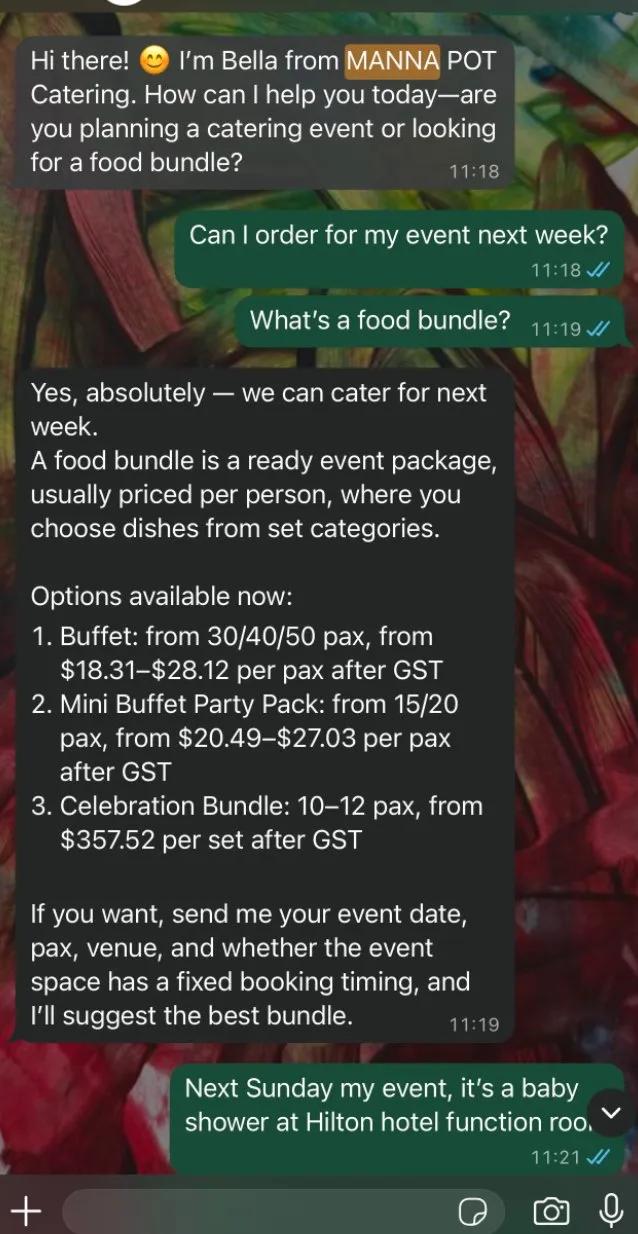
Customer order intake. Customers continue messaging Manna Pot through WhatsApp the way they always have. Odello reads the message, applies context from the customer's history and product catalogue, asks clarifying questions where needed, generates pricing, and confirms the order. All in conversational form, all without a human typing.
Staff communication support. When the team needs to respond to enquiries that aren't standard order intake (special requests, escalation, unusual logistics), Odello helps draft and refine messages so the team's communication is consistent in voice and clear in meaning, without requiring every staff member to be a trained copywriter.
Delivery and logistics handling. Odello manages ETA tracking and proof-of-delivery information across the operation, which means when a customer asks "when's my order arriving?" or "did the food get delivered?", the system knows the answer without anyone manually checking a delivery app or calling a driver.
The deployment included a structured user acceptance testing phase. Six functional categories were tested across more than 100 individual test cases, covering order management, customer support, procurement workflow, finance integration, logistics planning, and kitchen operations. The system went live in production once UAT signoff confirmed the AI was reading Manna Pot's specific customer language correctly, applying their pricing logic accurately, and handling edge cases in their actual operational context.
The implementation also included a series of customisations specific to Manna Pot's workflow: invoice format adjustments, consolidated billing logic for repeat corporate customers, bundle quantity handling for multi-dish orders, and integration with Manna Pot's website. All delivered within the agreed customisation budget. None of these are headline features. They're the operational reality of running a real catering business, and getting them right is what separates a deployment that runs from a deployment that stalls.
What changed
Two months after go-live, Manna Pot's operational shape looks materially different.
Around 92% of incoming customer orders are now handled end-to-end by AI. That's first customer message through pricing, confirmation, and entry into the operational system, with no human typing required. The remaining 8% are typically edge cases the AI escalates for human handling: unusual customer requests, escalations, or scenarios where the AI is configured to require human approval before sending.
Order admin time is down by approximately 85%. The team that previously spent most of every working day reading messages, looking up products, generating quotes, and entering orders has been freed to focus on the work that requires human judgment. Relationship management, complex catering events, customer follow-up, and food production planning.
Around 30% of total order volume now arrives between 9pm and 9am. Before automation, this volume routed to a queue that the team would only address the next morning. Now those messages get the same response speed as a 2pm enquiry. Customers see instant pricing and confirmation regardless of when they message.
The team's day looks different
The shift in operational shape isn't just measurable in percentages. It's visible in what the team actually spends time on now.
Order admin staff have been redeployed onto sales follow-up and customer relationship management. The kitchen team has clearer order visibility because confirmed orders flow into the system in a structured format rather than arriving as a Friday afternoon scramble of WhatsApp screenshots. The finance side runs cleaner because invoices and payment confirmations are tied to structured orders, not retyped from messages.
What the team focuses on now: customer relationship management, sales follow-up, handling exceptions and complex requests, operational coordination, and the higher-value work that actually requires human judgment.
"AI is not removing the need for people," Belicia says. "It is removing the need for people to keep doing low-value repetitive work that technology can already handle better. In a manpower-constrained, high-labour-cost environment like F&B, that matters a lot."
"We went from manually processing every catering order to having AI handle intake, payment collection, and order confirmation automatically. Our team now focuses on food quality and customer relationships instead of chasing WhatsApp messages," Belicia says.
The accounting system Manna Pot has been running for years was kept untouched throughout the implementation. Odello integrates with it via API. Orders and payments flow into it; nothing flows back to be retyped. Belicia's bookkeeper's day didn't change. The operations team's day did.
The hardest part was not the technical setup
What Belicia describes as the most interesting part of the journey is something most AI vendors and integrators don't talk about openly: the technical setup wasn't the hardest part of the deployment.
"The hardest part was the mindset shift," Belicia says. "Getting people to trust the system. Helping teams see that AI is there to support them, not replace them. Building the right safeguards and guardrails around company data. And leading the business through change in a way that feels practical, not threatening. That, to me, is the real work of transformation."
The eAI team approaches every deployment with this in mind. The trust readiness curve and the technical readiness curve are different curves. Operators who try to skip the trust work in favour of pure technical speed end up with deployments that stall. Operators who build trust deliberately while the technology gets configured end up with deployments that survive contact with reality.
What this journey validates
Three things this deployment shows clearly.
First, AI works best when it is tied to a real operational pain point, not adopted because it is trendy. Manna Pot's deployment was driven by a specific commercial reality (a failed previous vendor) and a specific operational pain (the manual order admin bottleneck on the team's time). The metrics improved because the deployment solved real problems, not because the technology was impressive in a demo.
Second, an F&B business does not need to choose between people and AI. The goal is to use AI to free people up for the work that actually matters more. Manna Pot didn't reduce headcount on order admin; it redeployed that capacity onto higher-value relationship work. The team got more meaningful jobs, not fewer jobs.
Third, sometimes a crisis forces the clarity you would not have arrived at otherwise. Manna Pot's previous ERP failure looked like a nightmare at the time. It became the trigger for a much better, more future-ready solution. Many SG SMEs are sitting on legacy systems that aren't quite working but aren't quite broken enough to force action. The lesson: don't wait for the failure.
Where Manna Pot is now
Manna Pot is now in a stronger operational shape than it was before either the previous ERP or the bottleneck. The catering business runs with eAI by TreeDots as part of a larger sales, CRM, and operations ecosystem. Odello handles the customer-facing operational layer. The finance system continues to handle finance. The team focuses on the work that actually requires their judgment.
The tangible impact is already clear: less repetitive work, leaner manpower needs, faster customer response time, and a more scalable business model. Manna Pot is also extending the AI layer from B2B catering into B2C consumer ordering, where scaling channels becomes a configuration question, not a hiring question.
"This is what AI should do for SMEs," Belicia says. "Not just look impressive. But solve real-world business problems."